CHAINS OF RECIPROCITY

CHAINS OF RECIPROCITY

Someone has done me favors in the past, when I needed them, say got me out of trouble. I naturally feel indebted to *that* person. But the ethical reaction should not be to pay the same person back since his generosity, if genuine, should be unconditional. My debt should be to the system (something called “society”), or, less abstract, someone else, preferably a stranger…

This is similar to the mechanism of bedouin hospitality. And it becomes multiplicative.

Likewise, like anyone who isn’t a saint, I have done things in my past for which I have remorse. But, to clear my conscience, I do not have to rectify the *exact* situation. I just need a large action that does not benefit me but helps the largest number of people, say, take risks by going after evil such as Monsanto, debunk BS vendors, prevent Hilary Clinton from getting close to the White House, etc.

—-

It is nearly impossible to change one’s opinion about ideas without *also* changing one’s opinion about the people associated with them.

The best way to know people is to find out what they lie about.

via: Facebook
Why GMOs are pretty much a lost cause, economically

talebGmo20150829

Why GMOs are pretty much a lost cause, economically.
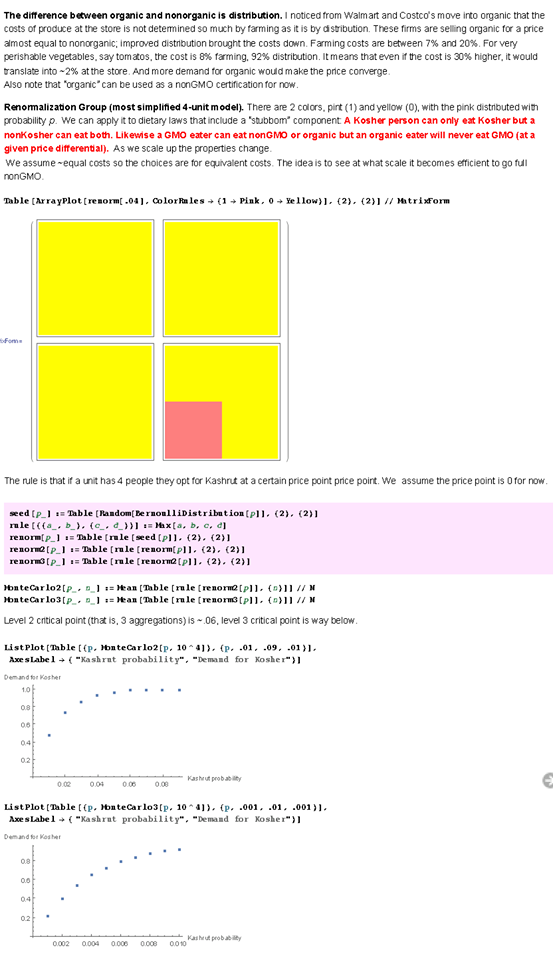
There is an asymmetry as follows. A tiny proportion of “stubborn” eaters could determine the consumption habits of the entire country. It is a key that Kosher people (representing <.3% of the US population) do not eat nonKosher, but nonKosher people eat Kosher. Many goods are Kosher but nonKosher people can’t tell because they do not recognize the small cryptic (U) or (K) sign on the can.
Which is why it suffices that a tiny portion of the population becomes “stubborn” NonGMO for the entire food to be NonGMO.
Now I discovered that the difference in price at the supermarket level between organic and nonorganic comes from distribution, not production. Production costs play a tiny role. Costco and Walmart are now into organic (they represent about 4% of US GDP) and growth of organic would not depend on demand, but on distribution efficiency.
—
Where does this nonlinear effect come from? If the price differential is small, it is easier at a wedding to accomodate NonGMO people by having everybody eat so, rather than introduce a new category. Same thing at the level of a restaurant or a supermarket. This “scaling” is called renormalization group. I did a bit of work to show the asymmetry in attached exercise. Ignore the exact numerical details; what matters is the nonlinearity, how things tip one way. The moral: the GMO industry spends time “converting” journos and others, but all this is a waste of time when it radicalizes a segment of the population.
—–
INSPIRED BY A CONVERSATION WITH SERGE GALAM.
—
PS: Got the GMO renormalization result in closed form: Renorm(n):=1-(1-p)^{4^n}… was too obvious.

via: Facebook

Folta, GMOs, Friedman, Charlatans | Twitter

https://twitter.com/nntaleb/status/640191057733513216

https://twitter.com/nntaleb/status/639926247477374976

https://twitter.com/nntaleb/status/639992344209698816

https://twitter.com/nntaleb/status/639599438915334146

https://twitter.com/nntaleb/status/639402560995131392

https://twitter.com/nntaleb/status/639254244529414148

Shameful. Let us clean up science. This is not about smalltimer Folta but about corporate control of science. https://t.co/dhhF4jhjXU

— NassimNicholasTaleb (@nntaleb) September 5, 2015

FAA should manage GMOs https://t.co/pZDZI175T8

— NassimNicholasTaleb (@nntaleb) September 4, 2015

GMOs Facts and Fiction: a cheat sheet (Revised). (Added the “consensus” needed for plane safety.) pic.twitter.com/09SmfaK3ck

— NassimNicholasTaleb (@nntaleb) September 5, 2015

OK, OK, after 10 years, I take Tom Friedman out of the dog house. https://t.co/Vu3QJvtQND

— NassimNicholasTaleb (@nntaleb) September 4, 2015

No, I don’t *talk* about refugees. Why? Because I am housing 6 Syrian refugees in Lebanon. #Skininthegame.

— NassimNicholasTaleb (@nntaleb) September 3, 2015

A Wonderfully Simple Heuristic to Recognize Charlatans | Farnam Street https://t.co/c3cKhrqQsv via @farnamstreet

— NassimNicholasTaleb (@nntaleb) September 3, 2015

GMOs , Joseph Traub, Emanuel Derman | Twitter

https://twitter.com/nntaleb/status/637657068439269376

https://twitter.com/nntaleb/status/637586097363677184

https://twitter.com/nntaleb/status/637023157501739008

Got the GMO renormalization result in closed form: Renorm(n):=1-(1-p)^{4^n}… was too obvious.

— NassimNicholasTaleb (@nntaleb) August 29, 2015
RIP Joseph Traub. In 1996, at a conference, I used his name tag. Someone:”Thought Traub is older”. R:”I eat healthy” http://t.co/yHuN44rV54

— NassimNicholasTaleb (@nntaleb) August 29, 2015
With @EmanuelDerman before our lectures making snide comments trying to confuse the speaker while looking serious. pic.twitter.com/rGTJK4i81s

— NassimNicholasTaleb (@nntaleb) August 27, 2015

‘Very tough’ for Fed to normalize: Taleb | CNBC


The Federal Reserve faces a “very tough” task in normalizing monetary policy, as it has limited tools at its disposal after years of near-zero interest rates, academic and writer Nassim Taleb said Friday.
“The Fed is like a huge army with very sophisticated equipment and no ammunition,” he said in a CNBC “Power Lunch” interview.
“They inherited that big machine without weapons. They realize that interest rates at zero is not something normal. And there’s no evidence that zero interest rates is better than 3 percent. But how to get to that normal level is going to be a very, very tough task for them,” the author of “The Black Swan” said.

Source: ‘Very tough’ for Fed to normalize: Taleb