NECSI Executive Education: Antifragility | NECSI


NECSI Executive Education: Antifragility
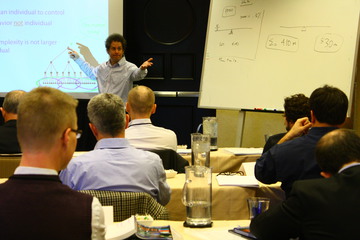
Antifragility: A User’s Manual
Learn to flourish in a volatile and complex world by creating “antifragile” organizations that thrive on stress and disorder. A two-day program for senior management January 21st and 22nd, 2016 Cambridge, MA
Speakers:Nassim Nicholas Taleb, Former trader,author of The Black Swan and AntifragileYaneer Bar-Yam, President and Professor,New England Complex Systems Institute
Frame:When strong winds blow, don’t build walls, but rather windmills: there is a way to turn every bit of adversity into fuel for improvement.This course introduces the principles of antifragility and complex systems science to explain how organizations and markets respond to volatility. Participants will learn which organizations can be considered fragile or antifragile, why certain patterns and trends matter while others are just noise, and how to create organizations that use volatility, variability, stress and disorder as information for making better decisions. This program does not require a math background.

Source: NECSI Executive Education: Antifragility | NECSI

Halloween, Mini-Certificate, Beirut, Employees

https://twitter.com/nntaleb/status/660216033349775360

https://twitter.com/nntaleb/status/660182249858428928

https://twitter.com/nntaleb/status/660055825054957568

The Mini-Certificate

MINI-CERTIFICATE IN REAL WORLD RISK MANAGEMENT*

One-week intense workshop: Feb 22-26 2016, New York City, 9 AM-5 PM

Nassim N. Taleb will deliver about half the lecture and sign the certificate

2 day program (no mini-certificate), $2950*

5 day program (with mini-certificate),  $7400*
(Early signup discount $2200 and $5900 respectively before Dec 15 2015)

* Inaugural price

The venue is expected to be the Princeton Club of NY in Midtown Manhattan or an equivalent outfit.

Note: Discussions include no equations, but a lot of concepts and pictures

http://www.realworldrisk.com/

https://twitter.com/nntaleb/status/660050334543273984

https://twitter.com/nntaleb/status/659449114191523841

https://twitter.com/nntaleb/status/658987521074925569

The minority rule explains the new Halloween (and why Europe will eat halal, why GMOs bust) https://t.co/aqvZRfOBil https://t.co/MLqXhg53Ji

— NassimNicholasTaleb (@nntaleb) October 30, 2015
After all this (secret) unremitting work I finally completed my small personal time machine. Future vs present. pic.twitter.com/RFMjs3k7Nx

— NassimNicholasTaleb (@nntaleb) October 30, 2015
Finally, our Mini-Certificate in Real World Risk Management anti-BS anti-Nerd approach. https://t.co/MOQV9AvJmY

— NassimNicholasTaleb (@nntaleb) October 30, 2015

First book lecture in French; In Beirut with French Lycée classmates attending. pic.twitter.com/B6dm6dXANY

— NassimNicholasTaleb (@nntaleb) October 30, 2015
My point about Switzerland isn’t that it doesn’t have a government. What It doesn’t have is much of a *central* government: *subsidiarity*.

— NassimNicholasTaleb (@nntaleb) October 28, 2015
Employees are more risk averse, they fear being fired more than contractors do being sued. @ArthurB https://t.co/2VlvtOsuia

— NassimNicholasTaleb (@nntaleb) October 27, 2015

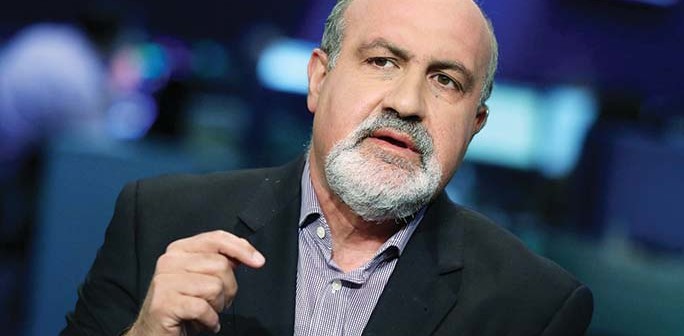
Nassim Nicholas Taleb: The danger of debt | The Sunday Times Post

taleb-pic1-684x336

But in this instance, the government came in indiscriminately to bail out everyone. So let’s zoom out seven years later – is it seven years already? – and look at what’s happened.

Well, what has happened is nothing, nothing, nothing, nothing new. We did not learn. We have had some kind of pseudo-recovery, mostly fuelled by an increase of debt. So the pool of debt has increased, and at low interest rates from the Fed, which don’t seem to be effective.

Now you have to realise that debt is only to be judged when you pay it back. Life should not be a Ponzi scheme which collapses when you have to pay it back. Is there an element of Ponzi in debt? Well, there’s some element that’s not Ponzi in debt – that’s small – and there’s a Ponzi element. So we didn’t learn much from the crisis. If we look at the narrative in 2009, it was healthier then.

But the efforts of governments in making things cosmetically look good now have been bad.What we didn’t learn from the crisis is that debt and leverage is bad, and we didn’t learn that economists are full of baloney. I have busted them mathematically. Between 2009 and now, I’ve published 45 technical papers, and I have ten more under review by journals. I have found arguments of theirs that are not valid empirically, but no one seems to care.

Source: Nassim Nicholas Taleb: The danger of debt