Just because it was inspired by ‘The Black Swan’. It’s encouraging to me to see NNT’s ideas spreading.
Can You Solve This?
Leave a reply
Just because it was inspired by ‘The Black Swan’. It’s encouraging to me to see NNT’s ideas spreading.
It took a lifetime to figure it out: I do not mind rich people, I instinctively avoid the type of rich people who only befriend rich (or famous) people.
via It took a lifetime to figure it out: I do not… – Nassim Nicholas Taleb.
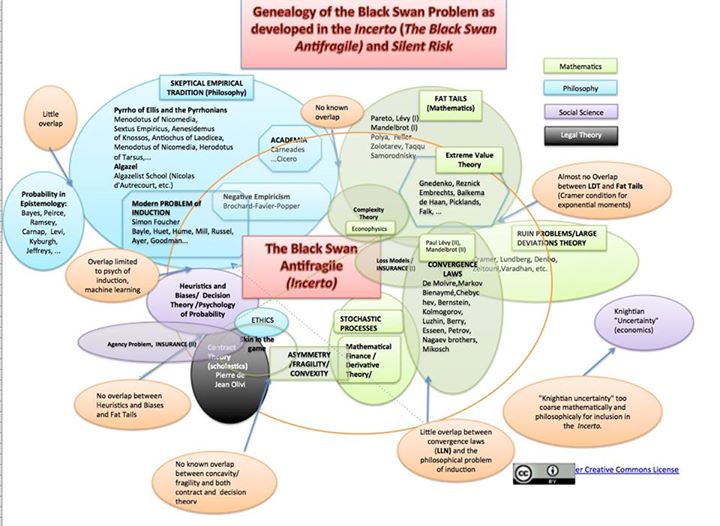
Final iteration of the map of THE INCERTO (mostly the Black Swan Problem), linking various traditions.
For a book to survive at least decade, it should not be summarizable, and if summarized, no two independent summaries should be alike.
via For a book to survive at least decade, it should… – Nassim Nicholas Taleb.
How? An answer to that question would probably require another speech. But I’d like to point in what I think is the right direction. And for that, we need to start with Nassim Taleb, the ‘enfant terrible’ of the academic world.
Nassim TalebTaleb has carefully cultivated the image of a bully for himself, somebody who likes to crush other people with his intellectual (and physical) powers. Recently he too discovered the power of the camera. In July he posted on Facebook about the “the magic of the camera in reestablishing civil/ethical behaviour”. I cite:
“The other day, in the NY subway corridor in front of the list of exits, I hesitated for a few seconds trying to get my bearings… A well dressed man started heaping insults at me ‘for stopping’. Instead of hitting him as I would have done in 1921, I pulled my cell and took his picture while calmly calling him a ‘Mean idiot abusive to lost persons’. He freaked out and ran away from me, hiding his face in his hands.”
Taleb has written one of the most important books of this century. It is called ‘Anti-fragile: Things That Gain from Disorder’ and it explores how you should act in a world that is becoming increasingly volatile. According to him, we have allowed efficiency thinking to optimize our world to such an extent that we have lost the flexibility and slack that is necessary for dealing with failure. This is why we can no longer handle any form of risk.